Late Archean magmatism, supercontinents, and the onset of plate tectonics
The timing of and processes related to the onset of modern-style plate tectonics and the assembly of earliest supercratons/supercontinents have long been vigorously debated. Since 2019, we have pursued a multidisciplinary research into late Archean plutonism and tectonic evolution of the Superior Province (Canada), Wyoming Craton (USA), and Kola–Karelia domain (Finland), which may provide the key information on craton collisions and thus on the complex and protracted transition from vertically-dominated plume tectonics that operated on Early Earth to plate tectonics that we see today.

Key papers
Žák J, Tomek F, Kachlík V, Vacek F, Svojtka M, Ackerman L (2026) Is the late Archean Superior Province, Canada, the oldest orocline on Earth? Precambrian Research, 439: 108109.
Žák J, Svojtka M, Sláma J, Tomek F, Kachlík V, Ackerman L, Vacek F, Trubač J (2023) Exploring the link between spatiotemporal patterns of plutonism and geodynamic regimes at the end of Archean: an example from the northeastern Superior Province, Canada. Precambrian Research 392: 107073
Ackerman K, Žák J, Kachlík V, Svojtka M, Tomek F, Santolík V, Sláma J, Trubač J, Strnad L, Vacek F (2022) The diversity of sources of late Archean granites reflects a transition from plume-dominated to plate tectonics in the Superior Province, Canada. Precambrian Research 370: 106525
Dynamics and tectono-magmatic framework of volcano–plutonic systems
We study volcano–plutonic systems across diverse tectonic settings, from magmatic arcs to collisional orogens. Combining structural analysis, geochronology, geochemistry, and gravimetry, we treat plutons as markers of regional strain and deformation history, tracing how magma emplacement responds to plate tectonics. At shallower crustal levels, we investigate magma flow beneath calderas and stratovolcanoes, along with eruption dynamics and emplacement of associated volcanic deposits. To link field observations with physical processes, we collaborate with Prof. Petr Kabele, Department of Mechanics, Czech Technical University in Prague, integrating numerical models with geologic data to simulate fabric development, magma cooling, diapirism, and caldera collapse.

Key papers
Olšanská I, Tomek F, Robustelli Test C, Zanella E, Svojtka M, Trubač J, Cifelli F, Finger F (2025) From magma formation to eruption: temperature path of two Late Carboniferous post-collisional calderas (Bohemian Massif). Geochemistry, Geophysics, Geosystems 26: e2025GC012217
Tomek F, Žák J, Verner K, Ježek J, Paterson SR (2024) A complex interplay between pluton emplacement, tectonic deformation, and plate kinematics in the Cretaceous Sierra Nevada magmatic arc, California. Tectonics 43: e2023TC007822
Somr M, Žák J, Kabele P, Tomek F (2023) Analysis of fracturing processes leading to caldera collapse.
Earth-Science Reviews 241: 104413
Mélanges, ophiolites, and accretionary wedges
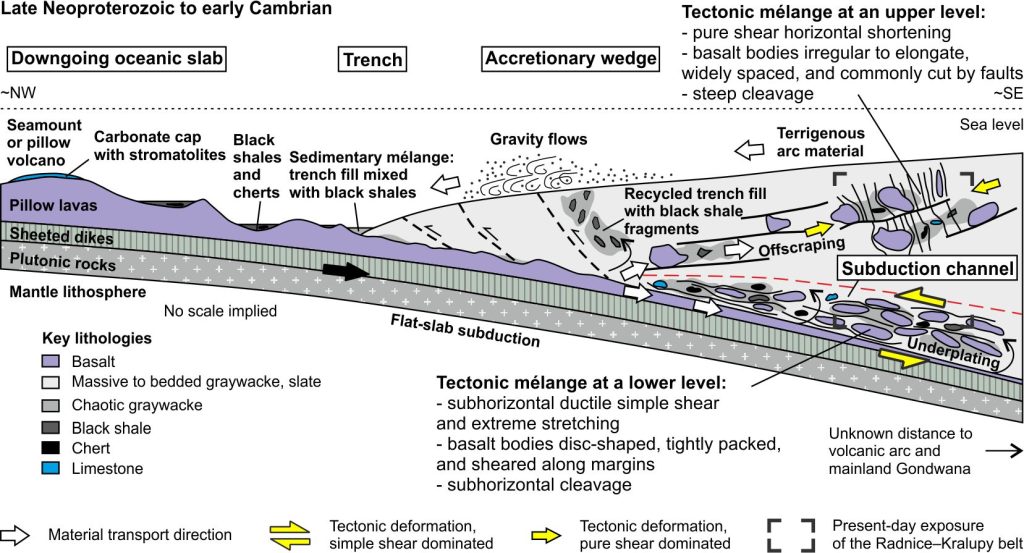
Subduction zones and the overriding accretionary wedges are one of the most dynamic tectonic settings on Earth. In this context, we have used the Ediacaran–early Cambrian Blovice accretionary complex, Bohemian Massif, as an excellent case example to reconstruct the Ocean Plate Stratigraphy (OPS), to understand the formation of OPS mélanges, and to explore mechanisms, temporal patterns, and time scales of growth of accretionary wedges. Another example, the Jurassic–Cretaceous Vardar suture zone in Serbia, has been investigated to understand mechanisms of ophiolite emplacement and their internal deformation during plate convergence. We also simulate these processes using analog experiments in our Laboratory of Experimental Tectonics using the TFM-1 apparatus.
Key papers
Tkáčiková T, Žák J (2026) Formation of sedimentary and tectonic mélanges during seamount subduction: new insights from analog modeling. Tectonophysics 924: 231085
Žák J, Svojtka M, Nance RD, Murphy JB (2025) Detrital zircon record of shutdown and migration of Cadomian volcanic arcs in the Bohemian Massif, with implications for Ediacaran to early Cambrian plate kinematics. Precambrian Research 422: 107786
Pellerey L, Žák J, Tomek F, Festa A (2024) Magnetic fabric of OPS mélanges: a tool for unravelling protracted histories of oceanic plates from sea-floor spreading to tectonic emplacement into accretionary wedges. Journal of the Geological Society 181: jgs2023-141
Detrital zircon geochronology and terrane provenance
Detrital zircon U–Pb geochronology has been widely used to interpret provenance of crustal fragments (terranes) displaced from the site of their origin and incorporated into younger orogenic belts. Our research uses the detrital zircon ages as paleogeographic indicators, aided by the advanced statistical methods such as multi-dimensional scaling (MDS). On the example of the late Precambrian Avalonian–Cadomian terranes, now dispersed within the Caledonian, Variscan, and Alpine–Carpathian–Balkans orogenic belts, we work on developing a general model of how detrital zircon ages potentially record terrane displacements along or away of continental margins.

Key papers
Ackerman L, Žák J, Svojtka M, Corradini C, Vacek F, Sláma J, Tkáčiková T, Tomek F, Míková J, Nance RD (2026) Late Precambrian to Paleozoic evolution of the Carnic Alps: new constraints on paleogeography and terrane transfer along the northern margin of Gondwana. Palaeogeography, Palaeoclimatology, Palaeoecology, in press: 113817.
Žák J, Svojtka M, Gerdjikov I, Ackerman L, Kachlík V, Sláma J, Vangelov DA, Kounov QA, Nance RD, Murphy JB, Míková J (2025) Enigmatic granite-gneiss domes within the Balkan fold-and-thrust belt, Bulgaria: tracers of Gondwana-Baltica proximity and large-scale terrane displacement during the waning stages of the Cadomian orogeny? Gondwana Research 151: 36-57
Svojtka M, Žák J, Kachlík V, Ackerman K, Tomek F, Vacek F, Sláma J (2024) Late Archean sedimentary basins in the northeastern Superior Province, Canada: Plume-generated crustal tears or syn-convergent accretionary belts? Precambrian Research 406: 107386
Application of rock-magnetic methods in solving geologic problems
We employ anisotropy of magnetic susceptibility (AMS), anisotropy of remanent magnetization (ARM), and paleomagnetic methods to analyze a wide range of geologic processes, including granitic magma emplacement and deformation, magma flow in dikes, growth of volcanic domes, formation and exhumation of metamorphic core complexes, and basin development. Our research is supported by the Laboratory of Rock Magnetism, equipped with state-of-the-art instruments including AGICO KLY5 Kappabridge, JR-6A spinner magnetometer, and a thermal demagnetizer, all housed in a magnetically shielded facility.

Key papers
Vitouš P, Petronis MS, Foucher MS, Tomek F (2026) Late Carboniferous geomagnetic field events recorded in post-collisional Altenberg-Teplice Caldera, Variscan Belt. Journal of Geophysical Research: Solid Earth 131: e2025JB031983.
Tomek F, Černý J, Lutovský M, Pospíšil L, Vitouš P, Sokol L, Danielová E, Hájková Z (2025) Did Forefather Czech know he was standing on a fossil lava lake? Revisiting the Oligocene Říp Hill volcano, Bohemian Massif. International Geology Review 67: 2119-2141
Olšanská I, Tomek F, Chadima M, Foucher MS, Petronis MS (2024) Magnetic multi-fabrics as tools for understanding ignimbrite emplacement processes: an example from late-Variscan Tharandter Wald Caldera, Bohemian Massif. Journal of Structural Geology 178: 105012